
Why Some Patterns Feel Impossible to Fully Shift

Why Some Patterns Feel Impossible to Fully Shift
Many people understand their patterns intellectually — yet still find themselves repeating the same emotional states, stress responses, behaviours or physical symptoms over and over again.
This is because lasting change is not created by the brain alone.
The nervous system and body also play a powerful role in reinforcing how safe, familiar or necessary a pattern feels.
The brain is constantly asking:
“Are we safe?”
And the body is continuously answering through signals linked to stress, inflammation, hormones, gut health, nervous system regulation and emotional conditioning.
If the body continues signalling stress, overload or imbalance, the brain may continue reinforcing the same automatic patterns — even when someone consciously wants change.
This is why The Life Reset work focuses not only on neural retraining and subconscious transformation, but also on supporting the wider internal environment influencing the brain and nervous system.
Because when both the brain and body begin working together differently, it becomes far easier to stop automatically recreating the past and create lasting transformation.
Why This Matters
Many people try to change their thoughts, behaviours or emotional responses — yet still find themselves pulled back into the same automatic patterns.
This is because the brain and nervous system do not work in isolation.
The body is constantly sending signals back to the brain about safety, stress, regulation and survival.
Over time, repeated stress responses, emotional conditioning, inflammation, nervous system overload and internal imbalance can all contribute to reinforcing the same patterns emotionally, mentally and physically.
Even when someone consciously wants change, the brain may continue interpreting the environment through the lens of stress, protection or familiarity.
This is why insight alone is often not enough to create lasting transformation.
As the brain and nervous system begin updating old patterns through neural retraining, emotional processing and nervous system regulation, the signals being sent throughout the body also begin to change.
At the same time, supporting the body’s wider internal environment — including stress physiology, gut health, hormonal balance, sleep and nervous system regulation — can help reinforce feelings of greater safety and stability within the system.
When the brain, body and nervous system begin working together differently, it becomes far easier to stop automatically recreating the past and reinforce healthier emotional, behavioural and physiological patterns over time.
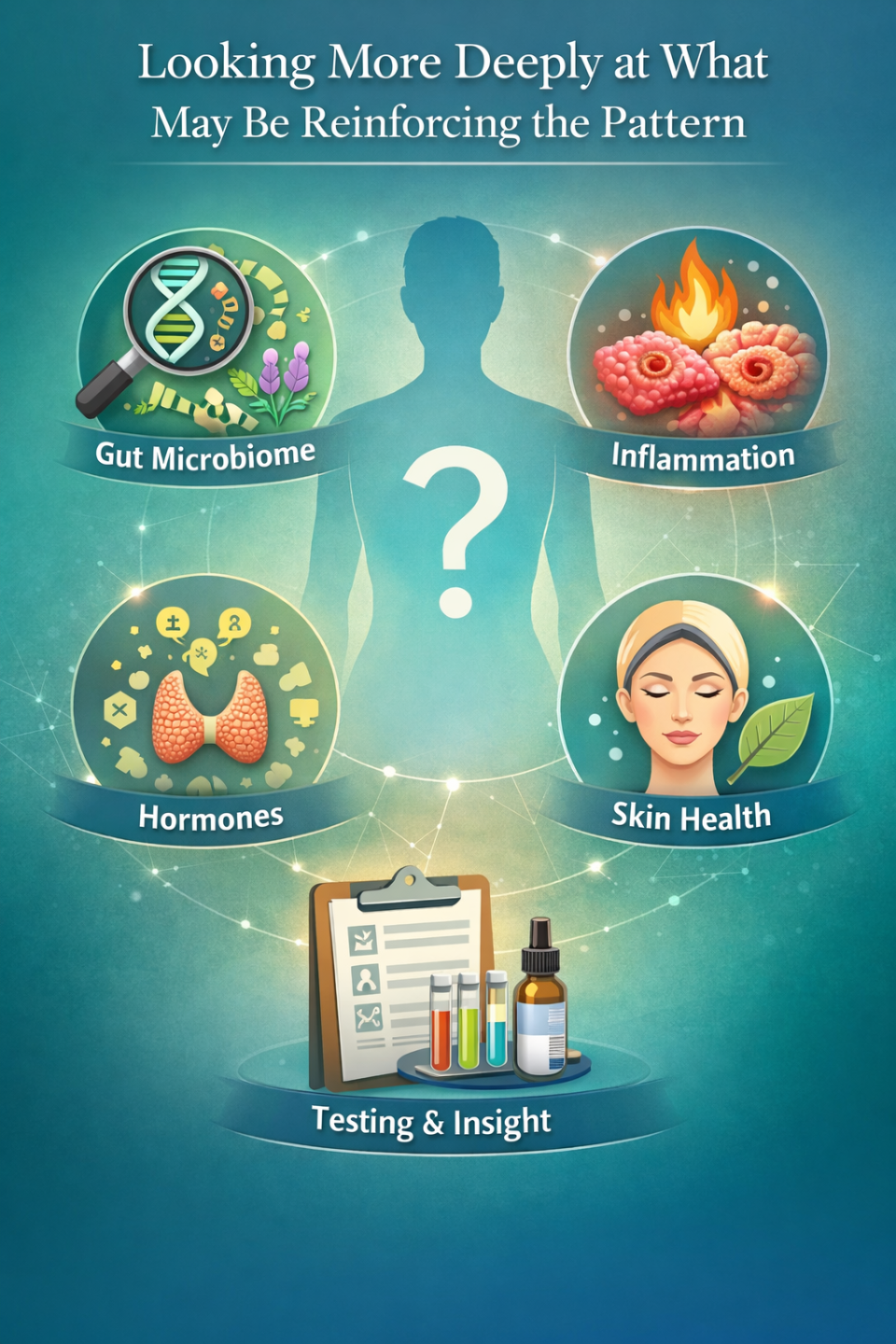
Looking More Deeply at What May Be Reinforcing the Pattern
For some individuals, deeper transformation may also involve exploring factors within the body’s internal environment that could still be reinforcing stress responses, nervous system dysregulation or automatic patterns.
This may include areas such as gut health, inflammation, hormonal balance, skin health, sleep, stress physiology and wider aspects of physical regulation and wellbeing.
These factors are not always the root cause, and they are not always where the work begins.
But in some cases, the body may continue signalling stress, imbalance or threat to the brain and nervous system — making it harder for new patterns to fully stabilise.
Understanding and supporting these areas can sometimes provide valuable insight into what may still be keeping the brain, body and nervous system locked into the same emotional, behavioural or physiological loops.
This is why The Life Reset work recognises the importance of supporting both the brain and the body when creating lasting transformation.
Supporting and Maintaining Change
Once the brain and nervous system begin updating old patterns, it becomes important to support the wider internal environment in a way that helps reinforce greater regulation, stability and long-term change.
For some individuals, this may involve exploring areas such as gut health, inflammation, hormonal balance, skin health, sleep and wider aspects of physiological regulation that could still be contributing to stress within the system.
When the body continues signalling imbalance, overload or dysregulation, the brain and nervous system may remain more likely to reinforce familiar survival-based patterns and responses.
This is why part of the work may also involve supporting the body in ways that help create a greater sense of internal safety, balance and resilience over time.
In some cases, this can include personalised insight through testing and guidance designed to help optimise and maintain the body’s internal environment more effectively.
The goal is not simply temporary change.
It is to create the conditions where healthier neural, emotional and physiological patterns can become more stable, sustainable and naturally reinforced over time.
